
|
| Home :: Herbalist :: Orchardist :: Family :: Farm |
|
 |
|
|
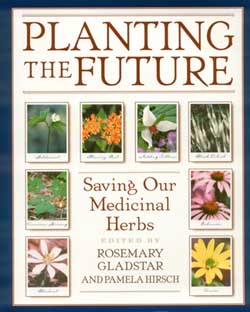
Planting the FutureSaving our Medicinal HerbsEdited by
about the book excerpt |
|
GoldthreadExcerpt by Nancy and Michael PhillipsGoldthread didn't readily reveal herself on our northern New Hampshire farm. The mixed balsam fir and spruce woods here certainly provide the expected habitat. Out on walks we would find ground cedar, partridgeberry, twinflower, and a myriad of mosses but not the glossy lobed leaves marking the golden roots sought for medicine. We put the case to our friend Andy; a botanical Sherlock Holmes if ever such a sleuth walked the forest floor. Ergo, we go back a hundred twenty plus years to the time this mountain farm first heard the ringing ax clearing virgin timber to open up pasture ground. Eastern goldthread, Coptis groenlandicum, is an old growth plant in its own right. Rhizomes along established roots sprout forth new leaf clusters thereby allowing the plant to spread. Andy reckoned any remnant patches we might find today would be traceable directly to the original twining roots that somehow survived decades of dairy cows and workhorses. We headed for rocky ground. Our woods are going through a first succession of shallow-rooted firs that, having toppled in gusty winds, have left a jumbled maze of soil-restoring logs to snag our way. Moss-covered rocks abound among the ferns, and sure enough, here and there we find the smallest clusters of goldthread, so precious we simply honor its persistence. The hike back leads along an alder bog where our feet press softly into luminous beds of moist moss. Our sleuth ponders: ground too wet, cows stay back, native plants endure. Goldthread awaits us on the western edge of the bog where deciduous shade adds to the cool of the evergreen forest. We sense roots might be gathered here should an individual in our family or community have a need of this medicine. A spiritual permission from goldthread herself will take place should such an occasion ever arise. Botanical Features | ||
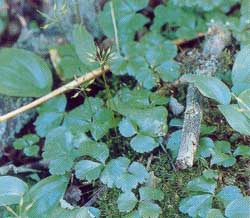
Threeleaf Goldthread (Coptis trifolia) photo: Martin Wall |
Goldthread is aptly named -- this dainty little evergreen plant of the buttercup family has bright gold threadlike roots. Its lustrous leaves rise from a rhizome base, each stem divided into three leaflets with scalloped, toothed margins. Each leaflet is usually less than 1.5 inches wide. C. groenlandica, which grows here in the East from Quebec south to North Carolina, stands 3 - 5 inches high. Western goldthread, C. occidentalis, grows slightly taller, perhaps reflecting its preference for mountainous terrain in undisturbed stands of cedar, yew, and grand fir. The whitish flowers of goldthread extend at the end of leafless stems. The five to seven narrow petals eventually fall off, leaving behind a green sepal that hollows into a star-shaped capsule that bears exceedingly small black seed. |
|
The thin roots form a creeping network of rhizomes from which the aerial parts of goldthread arise. These rhizomes generally spread in the rich organic matter of the forest floor rather than the mineral soil beneath. Goldthread helps loosen up this otherwise impervious mat of needle debris in the cool shade of evergreen woods. Boggier settings find the rhizomes quite at home in beds of sphagnum, often favoring the drier knolls surrounded by sodden ground. Historical BackgroundNative Americans had a ready supply of fresh goldthread available throughout the year for either chewing or making a tea. The vibrant gold roots, available even in winter under a blanket of snow, would have been as near as any old-growth forest. Good remedies naturally got shared with the colonists, leading to goldthread being so popular at one time that more of it was sold in Boston than almost any other indigenous drug. Such esteemed use fell to the wayside, most likely as our forebears' impact on the land altered the availability of this wee plant. The Eclectics didn't lose sight of goldthread, of course, and soon identified the two alkaloids, berberine and coptine, as its primary agents of unstandardized virtue. Equal parts of goldthread and goldenseal, made into a decoction, with elixir vitriol added in proper quantity, was said to permanently destroy the appetite for alcoholic beverages. (Apparently the prohibitionists ultimately decided on an allopathic approach.) Medicinal UsesGoldthread has traditionally been used for mouth sores and thrush, which explains its other common names -- canker root or mouth root. This strong bitter has also been used for a variety of digestive disorders, worms, jaundice, and as a so-called blood purifier. It is sometimes used in combination with or substituted for goldenseal, another at-risk plant. Both have berberine, a bitter alkaloid with strong antibacterial qualities. Goldenseal has been considered rare for over 75 years due to unceasing demand, and some herbalists concerned about its survival have suggested using goldthread in its place. This will never be a reasonable alternative on a broad scale as the fine roots of goldthread can't begin to meet our current (though sometimes erroneous) zeal for goldenseal. Transferring such high demand to goldthread would soon bring about its extinction, so the better answer lies in using cultivated organic goldenseal with sustainable discretion. Recent laboratory studies of a goldthread indigenous to China, Coptis chinensis, show promise against HIV, infectious hepatitis, and certain flu strains. Preparation and DosageThe simplest way to use goldthread is to chew the fresh root. This is effective for canker sores and mouth ulcerations. Goldthread is more commonly used in tea or in tincture form. Both preparations can be made with fresh or dried plant material. One tablespoon of fresh finely chopped root (or one teaspoon of dried root) per cup of boiling water simmered for 20 minutes makes an effective decoction. This tea can then be gargled for mouth sores or applied frequently for thrush. It can also be taken internally as a bitter tonic, 1 tablespoon 3-6 times a day for an average adult, for chronic stomach inflammation or digestive problems. There are several ways to make tinctures, and in reviewing the literature concerning goldthread we found different ratios of root, water and alcohol suggested. Surprise, surprise! When in doubt, the "folkloric method" will always serve: Finely chop the whole plant and put this in a jar. Pour 100-proof vodka into the jar to completely cover the plant material, with a little extra vodka in the jar so everything can slosh around well (about 1-2 inches over the plant material.) Close the jar with a tight lid and let it sit for around 6 weeks and then strain. Singing healing songs and praying when shaking tinctures each day adds positive intentions to the medicine. Propagation, Cultivation and HarvestingWe first harvested goldthread with Kate Gilday and Don Babineau at their forest home just south of the Adirondacks. The trees here have only recently reclaimed the land first taken from the Iroquois following the Revolution. Goldthread flourishes in a hemlock vale along an open wetland. Prayers are offered to the plant spirits. Hands reach into the soft soil beneath the hemlock duff. Golden roots are revealed trailing from one leaf cluster to the next. Each of us gathers within a small circle of intimacy, fingering the root threads into piles while our thoughts roam deeply into the earth. The small basket would fill slowly alone, but together we quickly have enough of the very fine roots, rhizomes and accompanying leaves for Kate to make the pint of fresh tincture she and another community practitioner use every two years. We tuck any neighboring roots back beneath the soil to replenish the tiny radius of our harvest. Goldthread here gains new ground each year, nurtured by reverence and the rich forest compost of undisturbed ground. Goldthread is a plant of the boreal and transition forests that grows where humans tread lightly, if at all. Spaded clumps -- taken only from a vibrant Coptis patch -- can be carefully transplanted into suitable locations that offer shade and plenty of abundant organic matter. Trial "hither and thither plantings" to see if your vision is in accord with both the plant and the land. You need to move these delicate rhizomes and their trailing root systems with earth intact to have any chance of success. The seeds are small and easily missed as the goldthread flower quickly matures. Replenishing native species is an offering of restoration that transcends commercial intent. Nor does the extreme fineness of goldthread roots exactly encourage a medicinal livelihood. Greg Tilford puts this best in his book : "This is a plant to worry about and protect, not to exploit. Goldthread offers us a chance to redefine what 'value' really means and to take the gift of healing to heart instead of to the bank." The oriental species, C. chinensis, could offer innovative woodland growers better prospects as its larger roots offer an equivalent medicine. According to Robert Newman, former curator of the Nanjing Medicinal Botanical Garden, this species is cultivated successfully in China but awaits a North American appraisal. |
|
Bibliography
|
|
| Home :: Herbs :: Apples :: Contact Us :: Top |
|
recommend this page to a friend |
 |
|
send website feedback to the Heartsong Farm webster website by last updated 28 March 2006 :: 2:34 pm (Pacific) time this site generated with 100% recycled electrons! | |
website design and images copyright ©
website content copyright © Heartsong Farm all rights reserved, thank you | |