bar stripe
bar stripe
Lost Nation Orchard: growing organic apples with Apple Grower author Michael Phillips
leftie

Seasonal Checklist for the Home Orchardist

by Michael Phillips

Silver tip

  • Prune all bearing trees. You need to establish a generous framework of scaffold branches that allow maximum penetration of sunlight and drying breezes. Fungus diseases require a certain amount of surface wetting prior to infection: good disease control begins with pruning. Go observe well-pruned trees in a commercial orchard.
  • Remove or chip all prunings to prevent rot spores from establishing.
  • Order orchard supplies for the coming season. More often than not, organic alternatives are only available from mail order sources. Be prepared!

Quarter-inch green

  • Spread compost 1 to 2 inches thick under dripline of each tree. Boron needs are met with a sprinkle of Borax (twelve ounces will do a large tree) every three years. Similarly, apply up to several pounds of gypsum if fall soil testing indicates soil calcium levels are moderate to low.
  • Remove tightly wrapped trunk guards placed for winter vole protection.
  • A balanced organic fertilizer helps young trees grow a strong framework of branches quickly. One to two pounds of North Country Organic's Pro-Gro, a 5-3-4 blend, is available in New England. Cultivate a circle several feet in diameter around newly planted trees those first several years as well.
content
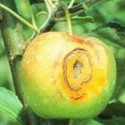
Cedar apple rust on the fruit can only be prevented early in the growing season. (photo: courtesy of Keith S. Yoder via the West Virginia University Fruit Web)

Pink

  • Primary scab season has begun. Protecting against infection now will prevent secondary infections throughout the summer. The first application of liquid sulfur goes on with NuFilm-17 (a sticking agent made from pine resins) before the next predicted rain. Rates per gallon: 8 tbs. liquid sulfur, 1 tsp. NuFilm-17, 2 tbs. liquid seaweed. Repeat this spray during bloom time immediately following a significant daytime rain (if such occurs) resulting in the leaves being wet six hours or more. The NuFilm keeps sulfur in place through lighter showers.
  • Cut down wild apple trees spotted in bloom within a hundred yards of garden to prevent pest migration to your trees. The exceptions here are those trap trees managed (i.e., pruned on occasion) as an "alternative home" for insects put off by Surround.
content
leftie The Apple Grower: A Guide for the Organic Orchardist -- click for book summary

Petal fall

  • Initiate kaolin clay coverage. Two or three applications of Surround are necessary from the get go to build up barrier protection from the imminent curculio invasion. Don't delay this spray: repellents only work if in place before the majority of the bugs arrive. Rates per gallon: 1/4 to 1/2 lb. Surround, 2 tbs. seaweed. Repeat 5 to 7 days later, taking into account the wash off factor due to a heavy rain.
  • Primary scab season usually ends with a daytime rain soon after petal fall. Be sure to renew sulfur coverage before this rain if more than a week has passed since the previous sulfur spray. Sulfur can be tank mixed with Surround.
  • Place drop clothes under trap trees if planning to destroy infested "June drops." Likewise, give those chickens a particularly rousing pep talk.
content
Support our Apple Grower Network! Hercules and his quest for the Golden Apples points the way!

Cover Sprays

  • Surround coverage needs to be kept up 4 to 6 weeks after petal fall. Thorough coverage tends to deter egg laying by first generation codling moth as well.
  • Alternatively, one can depend on the Bt mixture for excessive codling moth and lesser apple worm and/or oriental fruit moth pressure beginning approximately two weeks after petal fall. Spray all trees with a mix of Bt, fish oil (this serves as a UV inhibitor to prolong the bacterium's viability), and liquid seaweed. Rates per gallon: 2 tbs. Bt, 1 tbs. fish oil, 2 tbs. seaweed. Repeat every 3 to 5 days at twilight over a two week period. Moth eggs are hatching at this time, and the tiny larvae take only a day or two to eat their way into the sanctuary of a developing fruit, thus the need for frequent applications. Use seaweed in every spray mix as a foliar health tonic.
  • Thinning is perhaps the most telling action you can take to produce a quality apple crop and encourage return bloom next spring. Leave the largest fruitlet in each blossom cluster by stripping the rest away. Come back a week later to remove any insect-damaged fruitlets, leaving the select of the select every 6 to 8 inches along the branch. Dispose of the infested fruitlets.
  • Aerated compost teas and/or Serenade are useful in holistic disease management.
  • Scythe down the long grasses around fruit trees and rake as a mulch under the trees (but not quite up against the trunk itself).
content
Michael Phillips, organic orchardist -- click for more on Organic Orcharding
more from Michael Phillips:
Organic Orcharding

Those Lazy, Hazy, Crazy Days of Summer

  • Whitewash young tree trunks with diluted latex paint to prevent freeze/thaw injury in winter. The smooth white coating also helps in spotting borer egg slits, which are made by a striped beetle in July and August. Round-headed apple tree borer grubs need to be literally grubbed out of your trees with the tip of a pocket knife at first sighting to prevent two years of very destructive cambium chewing. Maintaining a thick kaolin paste on tree trunks these two months has merit against borer.
  • Hang out red sticky traps for apple maggot fly in the first week of July, 1 to 4 spheres per size of tree. Trap placement is integral to success -- hung at eye level in direct sunlight, but surrounded by developing fruit within 18 inches on all sides. Add a sphere along with an accompanying fruit essence lure to "wild trap trees" to direct the flies further afield (don't use lures if these draw flies to your crop trees however). Scrape away stuck insects and renew the sticky every few weeks.
  • Summer prune watersprouts (vigorous, vertical shoots) around August 1 to allow better air flow within the leafed-out tree. Sooty blotch and fly speck are superficial summer diseases that are best held in check by drying breezes.

After the Harvest

  • Check for borer grubs one last time before replacing winter vole guards around trunks of young trees. Pull all mulch back several feet from tree base.
  • Rake up and bury the fallen leaves beneath the tree to limit scab inoculum from overwintering. Similarly, pick all mummified fruit off the tree in order to remove the most likely source of rot spores.
  • Keep deer from browsing on next year's precious buds. Cayenne, garlic, liquid fish, and eggs make for a decent homegrown repellent. But nothing beats a high fence!
content

more on Organic Orcharding


bar stripe
bar stripe
Lost Nation Orchard: growing organic apples with Apple Grower author Michael Phillips btm
website credits
send website feedback to the Heartsong Farm webster
website by
last updated 8 November 2006 :: 9:40 am  (Pacific) time
this site generated with 100% recycled electrons!
website design and images copyright ©
website content copyright © Heartsong Farm
all rights reserved, thank you